Biopharmaceutical testing is the analytical work that confirms a large-molecule drug, a protein, an antibody, or another biologic, is what it claims to be. That means confirming identity, potency, stability, and concentration, and ruling out contamination introduced during production. It draws on a different toolkit than small molecule testing because proteins do not behave like simple chemical compounds, and a method built for a small molecule API will not tell you what you need to know about a biologic.
If your pipeline includes a monoclonal antibody, a fusion protein, or another large molecule candidate, you have probably already run into this. Your regulatory team is asking for potency data your CRO can’t generate in-house. Your CMC section needs host cell protein numbers nobody flagged as a gap until the pre-IND meeting. The testing plan that worked for your last small molecule program does not map cleanly onto this one, and figuring out which lab can actually run the assays you need, rather than just saying yes and subcontracting them out, becomes its own project.
Why Large Molecules Break the Small Molecule Testing Playbook
A small molecule API is a defined chemical structure. You can confirm its identity with HPLC, quantify impurities against a reference standard, and be reasonably confident that if the chromatography checks out, the molecule is what you think it is.
A protein or antibody does not sit still for that kind of test. It has a three-dimensional structure that affects how it works; it can aggregate or fragment in ways that change its behavior without necessarily changing its basic composition, and its biological activity, not just its chemical identity, is often the thing a regulator actually cares about. That means potency has to be demonstrated with a functional assay, not inferred from a purity number. It also means stability studies have to track things like aggregation and oxidation that simply do not apply to a small molecule tablet sitting in a stability chamber.
None of this is a reason to avoid biologics. It is a reason to make sure whoever runs your analytical program has actually built methods for large molecules before, not adapted small molecule methods and hoped they would hold up.
The Core Testing Battery: Identity, Potency, Stability, and Concentration
For a large molecule program, biopharmaceutical testing generally covers four things at minimum: identity, potency, stability, and concentration, along with enzyme assays where the molecule is enzymatic. Identity confirms you have the molecule you think you have. Potency confirms it does what it is supposed to do, at the level it is supposed to do it. Stability tracks how the molecule holds up over time and under stress, which matters more for biologics than for most small molecules because degradation pathways like aggregation are harder to predict. Concentration confirms dosing accuracy, which is a direct patient safety issue.
Each of these needs a method built specifically for the molecule class in question. A potency assay for a monoclonal antibody looks nothing like a potency assay for an enzyme replacement therapy, and a lab that treats them as interchangeable is going to generate data that does not hold up under regulatory scrutiny.
Host Cell Contamination and Impurity Testing Are Not Optional
Biologics are produced in living systems, cell lines, bacteria, or yeast, and that production process introduces its own contamination risks that a small molecule synthesis never has to account for. Host cell protein and host cell DNA testing confirm that residual material from the production organism has been cleared to acceptable levels. This is not a nice-to-have. It is a standard expectation in any regulatory submission for a biologic, and it sits alongside the broader impurity analysis work that any well-run analytical program should already have built into its process.
Skipping this, or treating it as an afterthought that gets bolted on right before filing, is one of the more common ways sponsors end up with a data package that raises questions instead of answering them.
The Instrumentation Question: Why Equipment Matters as Much as Method
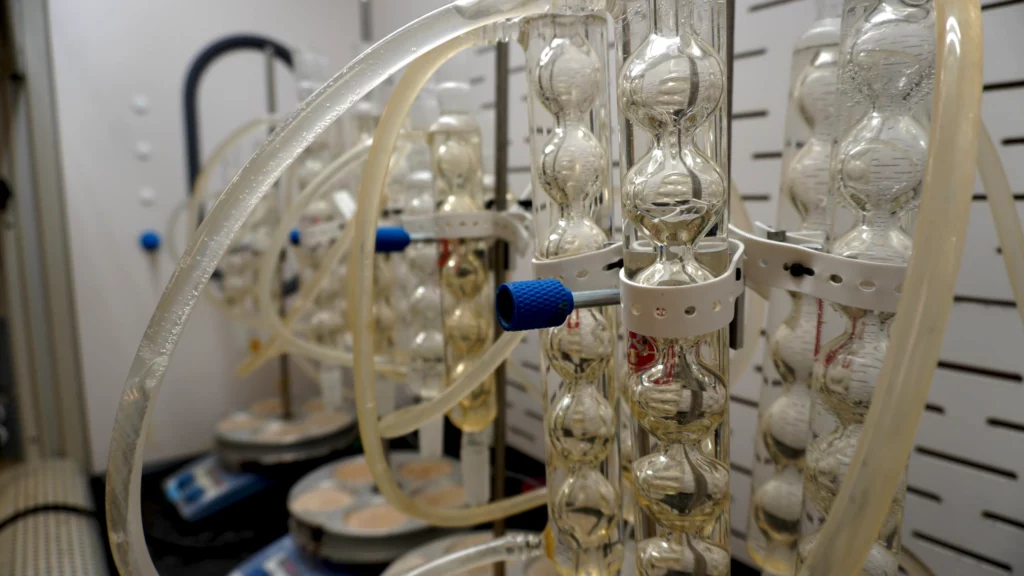
Method development for biologics depends on having the right instrumentation on hand, not general-purpose lab equipment repurposed for the job. Platforms like the SpectraMax i3x, Ella, and Maurice systems, paired with Applied Biosystems instrumentation, give a lab the ability to run identity, potency, and characterization work specific to large molecules rather than approximating it.
This connects directly to a lab’s broader analytical development capability. A lab running over 100 HPLCs alongside LC-MS, GC-MS, and ICP-MS for small molecule work has the depth of method development experience to build sound large molecule methods too, rather than treating biopharmaceutical testing as a separate, bolted-on service line with less institutional knowledge behind it.
Why a Scientist-to-Scientist Model Matters More for Biologics
Large molecule programs generate more open questions along the way than most small molecule programs do. An unexpected aggregation result, an assay that needs to be qualified faster than planned, a potency method that behaves differently at a new concentration range. These are the moments where it matters whether you are talking directly to the scientist who ran the assay or routing every question through a project manager who has to go find out and get back to you next week.
That direct line is central to how Quality Chemical Laboratories works. QCL’s lab management engages clients scientist to scientist rather than through layers of account management, which matters most exactly when a program hits one of these unplanned moments. QCL has been running this way for over 25 years, is FDA and DEA registered, and operates as a single Wilmington, NC campus under one quality system rather than a network of facilities with inconsistent standards from one location to the next.
Common Questions About Biopharmaceutical Testing
What is the difference between biopharmaceutical testing and small molecule testing? Small molecule testing generally confirms a fixed chemical structure using chromatography against a reference standard. Biopharmaceutical testing has to account for a molecule’s three-dimensional structure and biological function, which means potency, stability, and identity all require assay types, like functional bioassays, that a small molecule program typically does not need.
Does host cell protein and DNA testing need to happen in-house, or can it be subcontracted? It can be subcontracted, but every hand-off adds time and risk to your regulatory timeline. Working with a lab that already runs impurity analysis and biopharmaceutical testing under one roof, using assay types like ELISA and real-time PCR, can move faster and keep the data package consistent since the same quality system governs both.
What instrumentation is actually needed for large molecule identity and potency testing? At minimum, platforms built for protein characterization and functional assays, such as the SpectraMax i3x, Ella, and Maurice systems alongside Applied Biosystems equipment. General-purpose small molecule instrumentation alone is not sufficient for this work.
How long does biopharmaceutical release or stability testing usually take? It depends on the molecule, the assay panel required, and where you are in the development timeline, from early characterization through GMP release testing. QCL’s business development team can put together a program-specific timeline once they understand the scope of your project.
Talk to a Lab That Runs This Work Scientist to Scientist
If you are choosing an analytical partner for a large molecule program, the questions worth asking are specific: What instrumentation do they actually run for potency and identity testing? Do they handle host cell contamination testing in-house? Will you be talking to the scientist who ran your assay, or to someone relaying an answer secondhand?
Quality Chemical Laboratories has been answering those questions for pharmaceutical and biopharmaceutical clients, from virtual startups to global pharma companies, for more than 25 years. To talk through your program’s specific requirements, request a quote, submit a sample, or reach the business development team directly at BusinessDev@qualitychemlabs.com or (910) 796-3441.